Be the Light: How One Brooch, One Story, and One Partnership Are Changing Lives
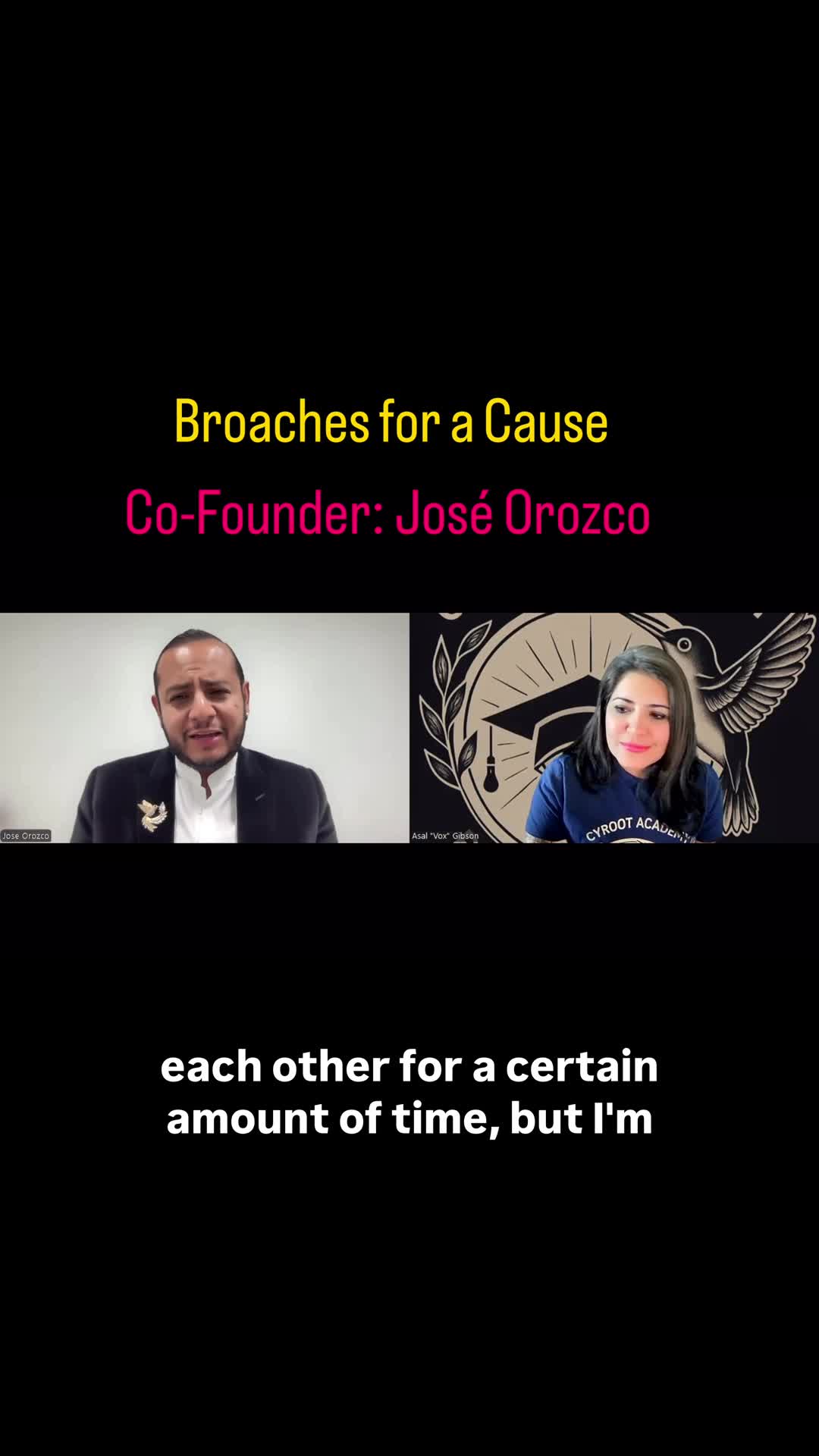
In this episode of the CyRoot Academy podcast, host Vox Gibson sits down with Jose "Bebo" Orozco — adjunct professor at UNLV, co-founder of the nonprofit Orozco Siblings, and co-founder of Broches for a Cause — for a candid, faith-and-purpose-driven conversation about identity, advocacy, and mentorship.
Jose opens up about his journey from a shy, humble-beginnings childhood in Mexico to building a career and a public voice in Las Vegas. He shares the unexpected origin story behind Broches for a Cause — sparked by a brooch he noticed in a holiday movie — and how it evolved from a personal style choice into a mission-driven brand where every brooch represents a nonprofit cause, opening the door for meaningful conversations about compassion and impact.
The conversation moves into Orozco Siblings, the nonprofit Jose co-runs with his sister to serve immigrant, asylee, and refugee communities through healing workshops, professional connections, English-language support, and access to technology like laptops. Vox and Jose reflect together on a recent youth event, "One Humanity, One America," where both shared their personal immigration stories with students — including an emotional moment when a young attendee said she wanted to grow up to be just like them.
Jose also shares reflections from his first semester teaching at UNLV, including a handwritten note from a student describing how a single class changed his life.
The episode closes with the announcement of a new mentorship partnership between CyRoot Academy and Orozco Siblings, designed to expose youth to a wider range of career and life paths — from cybersecurity to entrepreneurship to higher education — through shared mentorship and professional networks. Jose and Vox tie the conversation together with a reflection on CyRoot Academy's mission, "Be the Light" (Matthew 5:14), and what it means to actively choose to be a source of hope and advocacy for others.
Topics covered: immigration & identity · nonprofit leadership · Broches for a Cause · Orozco Siblings · youth mentorship · UNLV teaching · the CyRoot Academy x Orozco Siblings partnership · faith and purpose
Full Transcript
Note: This transcript has been cleaned up from an auto-generated transcript and corrected for proper names (CyRoot Academy, Orozco Siblings, Broches for a Cause, Vox). Speaker labels reflect best-effort identification based on context; a few exchanges shift quickly between speakers without clear audio cues, so some turns may be approximate.
Vox: All right. Hello, Jose. I'm so happy to have you on this new episode of CyRoot Academy. We've been friends and worked on multiple missions together, so I'm very grateful for your support. And I invited you here today to really tell your story and the impactful work you do here in Southern Nevada. So for those who don't know you, Jose goes by Bebo. He's an adjunct professor at UNLV — I had the honor of meeting some of your students last week, and they spoke so highly of you. They were huge fans, and that's a testament to who you are as a professional. Also, you're the co-founder of Orozco Siblings, an amazing nonprofit that I want to learn more about and want others to hear more about, and a co-founder of Broches for a Cause, which I personally benefited from, since you created brooches for CyRoot Academy — and they're all beautiful. So welcome, Jose. Tell us who you are.
Jose: First of all, thank you so much for having me. My God — like I said before, we've known each other for a certain amount of time, but I'm just so impressed by you as a leader stepping up to be an advocate for communities.
When it comes to our relationship specifically through Broches for a Cause, as you mentioned, we created some brooches with actual, beautiful meaning behind them. One of the things I always mention to people is how, growing up, I was always the shy kid in the corner. I never spoke with anyone. I was so afraid of being seen, of talking — of anything like that. Growing up, I realized that if I wanted to be someone established in life, I had to speak up. I had to utilize the voice that God gave me to really advocate not just for myself, but to create a bigger change in our communities.
So our brooches are so dear to me because someone asked me, "Why are they so big?" Because we're meant to shine brightly — we're never meant to dim our light for anyone. And like yourself, Vox, you're someone who is pioneering within our communities for military families, for veterans. It's not about doing it in a way that doesn't inspire other people to follow along — it's about showing the change. That's what Broches for a Cause is all about: shining brightly, understanding that it's okay to be who you are. Embrace every single ounce of yourself, because you're not made to be "perfect" — we need to embrace all of that in order to really create a change.
That's one of the endeavors I have with Broches for a Cause. And then, if we talk about our nonprofit, Orozco Siblings, it's about empowering the youth. I think back about my background, coming from very humble beginnings in Mexico, and never feeling like I belonged anywhere. I was always the odd child out, and I went through a lot of difficult situations growing up. I vowed that whenever I made it in life, I would be the person I wish I had growing up — someone to guide me, someone to let me know everything was going to be okay, and someone to give me those professional connections in order to become a success story.
We live in a time right now where there's so much darkness out there — so much. And it's up to us whether we choose to be the light, not just for ourselves, but for other people, or be part of that darkness. My life right now is really centered on creating impact, creating change — not financial success at all. It's more about how we can help communities, how we can empower people to understand that anything is possible in this world. It doesn't matter where we start in life.
Vox: I don't know if we need to say anything else — that was an amazing introduction. You know, when I think of you, I think of Sarah Ramirez, the CEO of Catholic Charities. When I went to her office, I had on this big flower brooch — I loved brooches, and this is why we're friends, right? I've worn brooches all my life, and to me it was more like a reflection of how I feel. I had different brooches for different holidays — it's an accessory, but it also reflected my personality. It meant more to me to choose the right brooch for an outfit than, say, an earring.
So when I was meeting with Sarah and she saw the brooch, she said, "You have to meet Jose, from Broches for a Cause." And I just loved hearing that — I'm like, "Oh my God, why didn't I think of that?" Because I love brooches. But how did this idea even come about? When did your passion for brooches start?
Jose: It happened just about three years ago. I was still trying to find myself — I had reached a certain level of success within the industry I worked for, but here specifically in Las Vegas, I just wanted to find my own identity, beyond just working based on profitability. I wanted to find my "why." That's really what it comes down to.
So I started exploring different ways of dressing. I started wearing blazers — back in the day I never wore blazers, so what you see now, which I wear every single day, is something pretty fresh for me. And I was watching a movie on Netflix — a Lindsay Lohan holiday movie — and her boyfriend in it had this humongous brooch. At least to me, it was huge. And I thought, "My God, that is so unique and beautiful — maybe I should get a brooch myself." That's where the passion started. I thought it was such a beautiful statement piece, and I started wearing brooches to every networking event I went to.
Back then, I did a lot of networking here in Las Vegas, and people would ask me, "Tell me about that brooch." And I'd say, "There's really nothing to tell — it's just a brooch I saw at this antique store," or whatever it may be. And that's where I realized I was missing an opportunity to create a change. People wanted to hear the emotional connection between the brooch and myself, but there was none. So I thought — with the current federal budget cuts for nonprofits, what if we created brooches that represent a beautiful cause, so that when people ask about the brooch, I can let them know what nonprofit it represents and why it's important?
I have a strong background in marketing, and I had spent so many years building for success that there was really no thought of building for impact, for actual intent. So I sat down with my sister one day, and we said, "Let's create a brooch company" — one that brings back compassion, where every single brooch represents something so beautiful and unique. Especially right now, I feel we've forgotten a little bit about emotions, about compassion, about humanity. So every single brooch stands for something we go through, through hardships — they all represent overcoming that.
It's something unique. We did our research across the market across the country — no one's doing it to the extent we're doing it. And what we realized is that we have something so unique that can really impact communities — it can spread the word about nonprofits and the beautiful work they're doing. And it's something we're so proud of doing.
Vox: That's so beautiful. And that takes me to Orozco Siblings — you invited us to be guest speakers at this amazing event you have for youth, "One Humanity, One America." That's your motto, correct?
Jose: Yeah. And the reason we started Orozco Siblings — when I say "we," it's me and my sister — is because we came from Mexico. I was six when I came into the country. I didn't speak English, we had no money — we literally started from the very bottom. A lot of the resources available now for certain communities were not available when I came. And one of the things we're seeing now is a lot of beautiful youth from beautiful backgrounds not having the resources to become true success stories.
I thought to myself, "Wait a second — I come from Mexico, I came from very humble beginnings. What am I doing to step up as a leader to help others, and more than anything, to unify our country and push it forward?" Because one thing I always say, Vox, is that it's not about being divided — it's about focusing on our humanity. When we focus solely on labels, we dehumanize people. We start to focus on what divides us rather than what we all have in common. And what I've learned throughout my life is that if we work as a team, we can create beautiful changes that push our economy forward, that push humanity forward — but it really requires leaders to step up.
The communities Orozco Siblings serves are immigrants, asylees, and refugees. I bring up those words because they carry a stigma — not a positive one — and that's what I mean about needing to look beyond labels, because they're humans first. We're all humans first. At the end of the day, if we want to push our country forward, we cannot leave people behind — we have to push everyone forward.
So with our nonprofit, we do a lot of workshops — we often call them "healing workshops," because we talk about emotions, about the struggles we have, and about how it's important to have respect for where we're at now while understanding there's a beautiful future ahead. Alongside that, we give professional connections, and we give individuals and families laptops, because we believe in the importance of understanding the English language — and we help in any way we can to make that happen for these beautiful families. It's not about criticizing, it's not about a victim mentality — it's about how we can combine all our resources and efforts to make these communities a success story and uplift everyone. That's really the main goal behind Orozco Siblings.
Vox: I love it. And for me, it wasn't just about seeing those beautiful kids and hearing the speeches — for me personally, it was an opportunity to tell my story, when I came to this country, and what that was like. I hadn't told that story publicly before, certainly not in front of an audience.
Talking to the kids, I remember their faces — I wasn't sure if it was landing or not. But I walked them through my journey, showing a picture of the humble house we had in Buffalo, New York. And at the end, I asked them to write something down — if you can dream it, you can do it. I told them: dream about being somebody or doing something, but write it down, because that's what turns a dream into an action. There's power in writing your dream down.
At the end of the presentation, one of the young ladies came up to me and said, "I want you to know that I wrote down: when I grow up, I want to be you." I got so emotional. That's when I felt like, "Oh my God — this is now a responsibility." Talking to youth is different than talking to adults. If you say something adults don't like, they just dismiss it — but it stays with young people. They look up to you, and they decide, "I want to grow up and be just like them." Now you've become a role model, and that keeps you grounded — it puts extra pressure and responsibility on you to keep showing up and being a good role model, for them and for other kids in the community.
Jose: I have to tell you, that was a gift you gave me — to be able to stand there, tell the story, and have one of the kids so impacted by it that they wanted to grow up to be just like you. I'm sure that was one of the biggest compliments you've ever received.
Vox: It really was. I thank you for putting that workshop together — when I was their age, I was never invited to anything like that. I think it was an amazing opportunity for everyone in that room, and I'd love to continue supporting you if you're open to doing a series of them.
Jose: You're giving me goosebumps. And that's what it's all about — creating impact, creating a beautiful change in someone. Growing up, I felt I didn't have access to people who were truly successful in their industries, so it was difficult for me to find a professional role model. The access we're giving youth through Orozco Siblings is access they otherwise wouldn't have. One of the things I'm always aiming for is breaking the stereotypes of what success looks like, first of all — and having someone of your caliber, Vox, my God, thank you so much for taking the time to do that, but especially for sharing your story of struggle and how you became this amazing individual changing the world.
People can connect with that. These youth connect with that, and they start to realize that it doesn't matter what we start out with in life — where we end up is a choice we make, because the resources are there. It's really a matter of looking beyond the victim mentality. And I know it's not exactly "proper" for me to say that, but it's true — we have to focus on our mission, because we all have a mission in life.
For me, teaching at UNLV is my first semester, and I received so many shout-outs on LinkedIn from my students — well over 25 of them. I was reading a couple this morning and I was in tears, because I never really understood the value of changing somebody's life. It's not just about financial success or building companies — life is so much more precious than that. I genuinely feel that when God gives us a gift, whether it's to speak up or to inspire others, we can't resist that process — we have to go for it. One of my students handed me a handwritten note, two pages long. At the very end, he said, "Words can't describe how much you changed my life through one single class." I thought to myself, imagine if we created a beautiful ripple effect at UNLV — with workshops, with getting people like yourselves to collaborate — the change we could create in this world, my God, anything is absolutely possible.
Vox: Honestly, thank you for creating that speech, for having that inspiration — even for that one person, though I know you've touched more than one. That is powerful, and you did that. So thank you — you brought me there. I appreciate that very much. And I know we've been talking about establishing a mentoring program — is it too early for us to announce that?
Jose: We can actually announce it.
Vox: All right! So tell me what you have in mind for the partnership with CyRoot Academy, and how you see it as a support system for "One Humanity, One America."
Jose: One of the biggest pieces of feedback I get from the youth I work with is that they don't see themselves in other people — representation makes them feel a lot more comfortable. So when they hear my story, when they hear your story, it's like, "Aha — if they did it, then why can't I?" In terms of a mentorship and collaboration between CyRoot and Orozco Siblings, it's about helping them see the opportunities in life — especially right now in the economy, and with where our country is at — by getting them to see everything from a macro perspective. Think about cybersecurity as an option, think about working for the state outside of cybersecurity as well. And the same for me — when they look at me, they start to think about university, about starting e-commerce businesses. So with this collaboration, we're creating different perspectives, and more than anything, we're empowering these kids through our own connections.
One thing I always tell people — I was asked to speak at the last UNLV board meeting about what we're doing, how we're creating change at the university — and I said it's about how every single one of us has a very strong platform, and we just keep it to ourselves. What a waste that is. So the whole idea is to utilize our resources to create these beautiful connections that are really shaping the future leaders of America.
Vox: I love it. I'm honored — it's a beautiful partnership we're creating. It's very meaningful, it's impactful on the community, and I'm really excited about it — for CyRoot, for my board of directors, for everyone to support and get behind. Our mission is to "Be the Light," and "Be the Light" comes from Matthew 5:14, when Christ said, "You are the light of the world, like a lamp on a hilltop that cannot be hidden." When I first came across this verse, it meant so many things to me — for someone to tell their students that... and you and I are both educators, right, and we pay our students lots of compliments, but to say "you are the light of the world" — there's huge magnitude to that statement. So I wanted to know, from your perspective, what does it mean to you to be the light?
Jose: I love that question. I gave a speech recently about exactly this, so I'll sum it down: my grandma would always tell me — I was at her deathbed, holding her hand, and things were really tough for me growing up, very tough — and she reminded me that there's a light at the end of the tunnel. There's always a light, just remember that. And that always stuck with me through the years — "Come on, I can't lose hope, there's always that light at the end of the tunnel."
But one thing I've learned, Vox, is that light isn't stationary — it's forever moving. And in that tunnel, it's so dark that the reality is: we are the light. Every time we choose to speak up on behalf of someone, every time we create a change, we are that light inside the tunnel. In the times we live in right now, we can either choose to be the darkness or the light — there's no in-between. So every time we do this level of collaboration, like the one we just talked about between Orozco Siblings and CyRoot Academy, we are being the light ourselves. We're holding the torch for people who don't have it easy. To me, the light is a privilege — understanding that we have that power, that every single one of us has that light inside of us. That's representative of the brooches as well — we have to shine brightly, we have to speak up, we have to advocate for communities. Otherwise, what are we doing?
Vox: I love it — that's well said, and it means a lot to me. It also seemed personal to you, from your experience with your grandmother — seeing how important it is, the things we say to people, and how they stay with them. So, always be kind. Always say kind things, and when you can't say something nice or kind, just don't say anything at all. It's important to spread that love, positivity, and light in our communities.
Jose, I'm so grateful for you and for this amazing partnership and friendship. I think you're an amazing person — we need more people like you, and we are influencing the next generation of youth to be the next "Jose" of the world. So I'm very, very grateful for that. Do you have anything else to add, or to tell our followers?
Jose: You are someone who embodies so many beautiful things in this world — by stepping up, by advocating for communities, and you're someone who does a lot of things privately as well to help people out. I am just in awe of you — you're exactly the type of leader we need, and we need more people to follow your example. Honestly, I'm just so blessed that we're collaborating, and I'm so honored to be wearing your "Be the Light" brooch — because honestly, you're shining such a beautiful light for so many people, and I am in awe and honored. Thank you so much for everything.
Vox: Thank you, Jose — I appreciate this very much, and thank you for your time. I'm sure we'll have another episode where we talk more about the program and what people should expect from it.
Jose: I love that. Let's do this — go out and be the light.
Vox: Love that. Thank you.